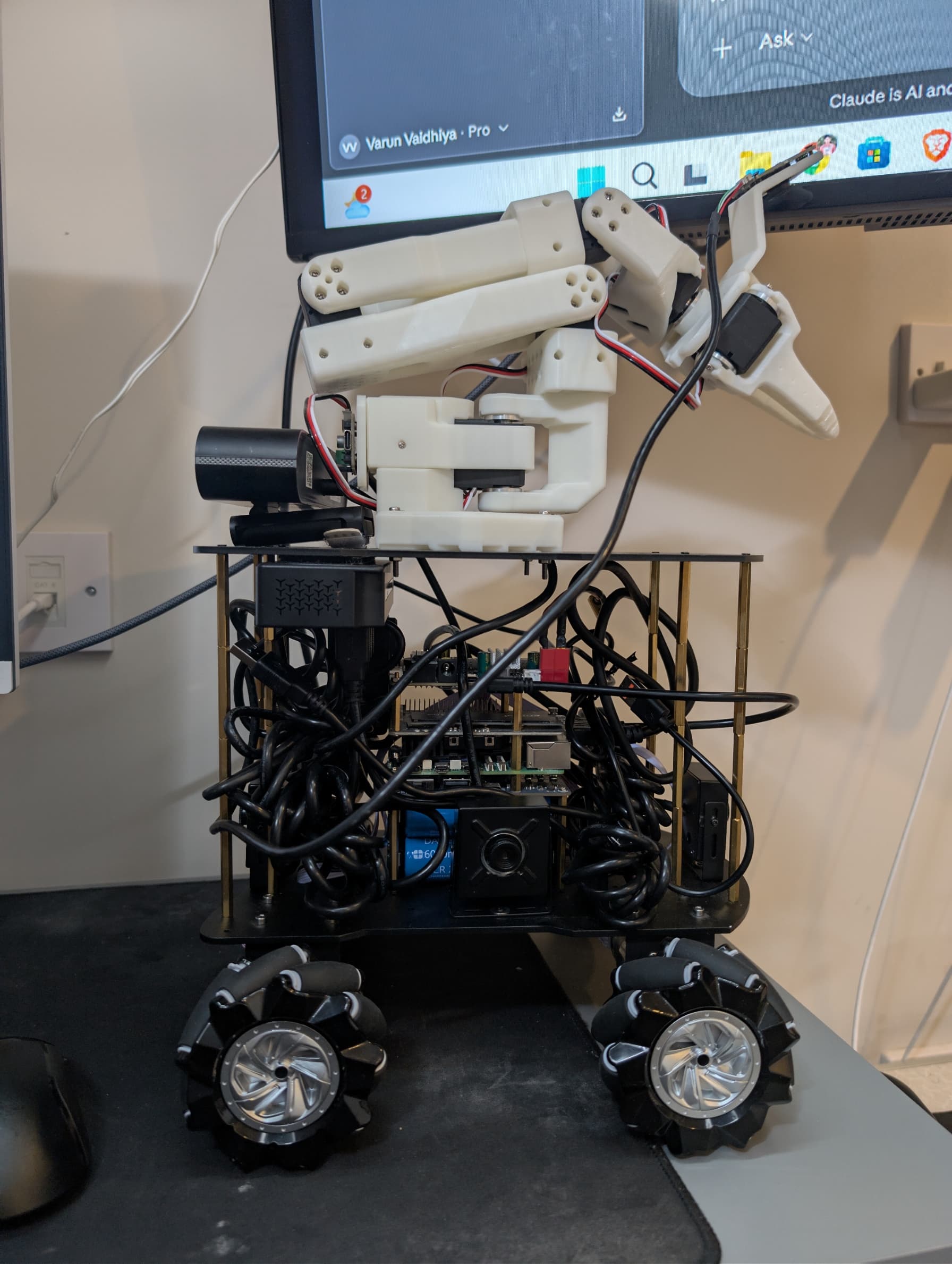
OmniBot
Flagship video and results
OmniBot is the reference robot in the public repository. Details are on the OmniBot page.
Video
In progress. The player slot stays empty until OHH-39 publishes a watch URL. A channel page is not that video.
Player slot empty. Nothing is embedded here.
Results
Vision: not built. The results source is OmniBot/docs/results.md. That file is absent from the public docs directory, so this table has no trial numbers.
| Item | Status | Evidence |
|---|---|---|
| Flagship video | In progress | Watch URL tracked on OHH-39. |
| OmniBot/docs/results.md | Vision: not built | Absent from the public docs directory. |
| Trials CSV | Vision: not built | Absent from the public repository. |
| OhhO Autonomy | In progress | Required for Built: code link, CI run, and video URL. |
| OhhO Connect | In progress | Required for Built: code link, CI run, and video URL. |
| OhhO Mind | In progress | Required for Built: code link, CI run, and video URL. |
| OhhO Twin | Vision: not built | Required for Built: code link, CI run, and video URL. |
Nothing is marked Built yet. The showcase rule is on the roadmap.
Tested on one robot.
Built with the tools in the code.
- Yahboom mecanum base
- SO-101 / Feetech STS3215
- Raspberry Pi 5
- Meta Quest 3
- ROS 2 Jazzy
- Nav2
- Gazebo
- LeRobot
- PyTorch
- FastAPI
- Unity / OpenXR
- Next.js
Open-source robots, first.
Open ecosystems, welcome.
Today: OmniBot. A Yahboom mecanum base and an SO-101 arm. Other open robots — humanoids, quadrupeds, drones — are a roadmap vision, not hardware this site runs. ROS 2 topics are the path for a robot that is not OmniBot.
Today the first-class robot is OmniBot. 3D-printed humanoids, open quadrupeds and open drones stay on the roadmap until a port exists in a public repository.
Any commercial brand that keeps its software layer open source and welcomes third-party developers into its ecosystem plugs in through OhhO's adapters. Closed, walled-garden platforms aren't the target — open up, and you're in.
Run inference on a desktop GPU, a workstation, a laptop, or a CPU-only board. OhhO Serve picks the execution provider that's present — no vendor-specific SDK is required to ship a policy.
OhhO targets open-source robots and open-source robot hardware first — wheeled, legged, humanoid, arm, drone or marine. It also embraces commercial brands that publish an open SDK and welcome third-party developers: capability-typed commands mean swapping hardware never rewrites your application, and per-brand adapters bridge non-ROS robots in unchanged.
Serve is model-agnostic by design — a vision-language-action model, an imitation-learning policy, a diffusion policy, an ONNX RL export, or a checkpoint you fine-tuned yourself. Your models and your data stay yours.
Keep the Pi and the laptop. There is no published cloud you can point a robot at yet. Hosted cloud is a waitlist, not a product.
Supported today, with public code: ROSBridge and Web Serial. Web Bluetooth is a Connect console demo; source is not public. DDS is experimental in the engine notes. MAVLink and Modbus are roadmap.
OhhO works with any brand that keeps its software layer open source and welcomes outside developers into its ecosystem. Closed, walled-garden platforms aren't the target — but if a vendor opens up, OhhO's adapters plug them straight in. Apache-2.0 engine, MIT tools, standard LeRobot datasets and ONNX exports mean you can leave anytime and keep everything you made.
never locked into
Open-source robots in. Open formats out. Standard LeRobot datasets, ONNX exports, ROS 2 topics and Apache-2.0 source — so the work you do on OhhO is portable to anything, forever. Open software and open ecosystems aren't a feature here; they're the whole point.
Read the open-source codeOne open engine under
every product.
OhhO OS 1.1.2 is ohho-os on PyPI. Source: ohho-os. TypeScript client: ohho-sdk. It drives OmniBot in simulation. It does not power 20 shipped products.
Most agentic robot stacks force a choice: go all-in on ROS, or abandon it entirely. OhhO OS runs both ways — a lightweight pure-Python runtime or the full ROS 2 stack — and you switch with a single argument. get_runtime("auto") detects ROS 2 automatically.
The engine's first-class robot is OmniBot (mecanum base + SO-101). Other categories — legged, humanoid, drone — are roadmap. A robot that already speaks ROS 2 can use topics.
The checked install includes ohho agent on the scripted fallback. The skill market console on this site is simulated, not a store.
Supported today, with public code: ROS 2 topics, ROSBridge, and Web Serial. Web Bluetooth is a Connect console demo; source is not public. CANopen, OPC UA, VDA 5050, PROFINET, and the other industrial protocols are roadmap. See the standards page.
Apache-2.0 licensed. The package is ohho-os on PyPI. There is no hosted service.
One robot, one engine.
The rest is roadmap.
OmniBot records, trains and serves policies on the open engine. Fleet regulation, a single bill and a cheapest-price claim are not products. Those consoles stay labelled Roadmap.
Design any robot in the browser, assemble it at the bench, and bring up a wired, calibrated, powered-on unit — starting from a blank canvas or an industry template.
Collect demonstrations, fine-tune VLA / imitation / RL policies, run sweeps and a continual-learning loop — then export a deployment-ready checkpoint or ONNX policy.
Serve the model behind a REST endpoint, connect OmniBot or the simulator over ROSBridge or serial, and teleoperate or run autonomy to put the robot to work — in sim first, then for real.
Ship policies over the air to a fleet of any size, monitor every robot from a single pane, and keep drivers, firmware and models current across mixed hardware.
Run the whole fleet day to day — observe and diagnose every robot, buy and sell skills in a marketplace, and keep the AI agent on task across the operation.
Close the trust loop — prove every behavior is safe and reproducible, stay ahead of CVEs, and certify against the standards your industry and insurers require.
Start with the core.
Grow into the platform.
View is a prototype, in progress until public OmniBot CI is merged (OHH-21). Connect, Data, Train, Serve, and the other prototype consoles use simulated data. Bench, Bridge, Market, Fleet, Twin, Care, Comply, Shield, and Proof are roadmap.
In-browser prototype that sketches a robot from a sample parts list and can export URDF and SDF. It does not source a bill of materials or design any robot for any industry.
Learn moreA prototype console. The public OmniBot repository has ROS 2 topics and a Gazebo lab world. Isaac Sim, MCAP recording, and multi-machine deploy are not built.
Learn moreConnect your browser to OmniBot or the simulator over ROSBridge (Wi-Fi) or Web Serial (USB) — with an in-browser simulator that runs with no install.
Learn moreA prototype console with simulated responses. 4-bit quantisation, Prometheus metrics, request batching, and a Docker single-command deploy are not built.
Learn moreFuse base-mounted cameras into a single calibrated bird's-eye-view your robot and your operators can both rely on. CPU-only, ROS 2-ready.
Learn moreLeRobot dataset recording scripts in the public OmniBot repository. The browser episode viewer is a simulated console (In progress). A record / inspect / push CLI is Vision.
Learn moreThe training engine behind the stack. Fine-tune VLA, imitation and reinforcement-learning policies from your OhhO Data episodes or in simulation — then export straight to Serve and Fleet.
Learn moreA prototype console on this site. Works today in the public OmniBot repository: Nav2 configuration, slam_toolbox mapping with Nav2, typed goals to named waypoints, and a teleop command mux. Mission planner, manipulation sequences, and open-ended language goals are not built.
Learn moreThe continuous agent brain that turns a command-taking robot into a goal-driven one. It perceives, reasons, verifies, acts, reflects and learns — on a loop — and ships to your fleet as an over-the-air update.
Learn moreA prototype console. The public OhhO-VR project uses Unity 6000.5.2f1. Dual-arm humanoid control, drone and underwater-vehicle schemes, and a stated video latency are not built.
OhhO VR pageGuided assembly, wiring and firmware bring-up. Turn an OhhO Build bill of materials into a wired, flashed and calibrated robot — with step-by-step instructions and hardware self-tests.
Learn moreRoadmap. The console lists protocol names. Only the Yahboom serial codec and ROS 2 topics exist in code. DDS, MAVLink, CANopen, OPC UA, Modbus, and humanoid joint maps are not implemented.
Learn moreA local skill-registry demo. Listings are simulated sample data, not verified policies you can download for a humanoid.
Learn moreRoadmap console with simulated fleet data. Signed over-the-air updates, VDA 5050, and Open-RMF are not implemented. Observability compose files exist in the private workspace and are not a hosted fleet service.
Learn moreSimulated console. A Gazebo world for OmniBot exists in the public repository. A live twin and OPC UA are not implemented.
Learn moreRoadmap console. Predictive maintenance, parts ordering, technician dispatch, and a repair log are not built.
Learn moreSimulated checklist only. OhhO does not generate a technical file or a conformity certificate, and it does not claim ISO, CE, UL, or SOC 2.
Learn moreRoadmap console. Hardware identity, encrypted links, signed updates, and vulnerability monitoring are not built.
Learn moreRoadmap console. Scenario batches, regression tracking, coverage maps, fault injection, and a safety-case report are not built.
Learn moreOpen platform.
Pay-as-you-go cloud.
Clone the repo, self-host every console, or sign in to use OhhO Cloud. MIT/Apache licensed — no lock-in. Works with any ROS 2 hardware out of the box.
Design robots in OhhO Build, collect episodes with OhhO Data, fine-tune VLA or RL policies locally. Need cloud GPUs? Pay only for the hours you run.
Cloud GPU training, AI inference API, MCP server hosting, cloud simulation — each billed per use. Everything else: free. No surprise bills, no minimum spend.
Free and open source.
The engine and the interactive console demos are free. There is no paid plan on this site.
Engine plus interactive console demos. Hosted cloud is not for sale yet.
Open-source robots,
first.
One open umbrella to build, train, launch, deploy, manage and regulate any robot — open-source hardware first, any brand with an open software layer welcome.
No credit card. No vendor lock-in. Pay only when you run GPU training, AI inference, or cloud simulation on OhhO infrastructure.